
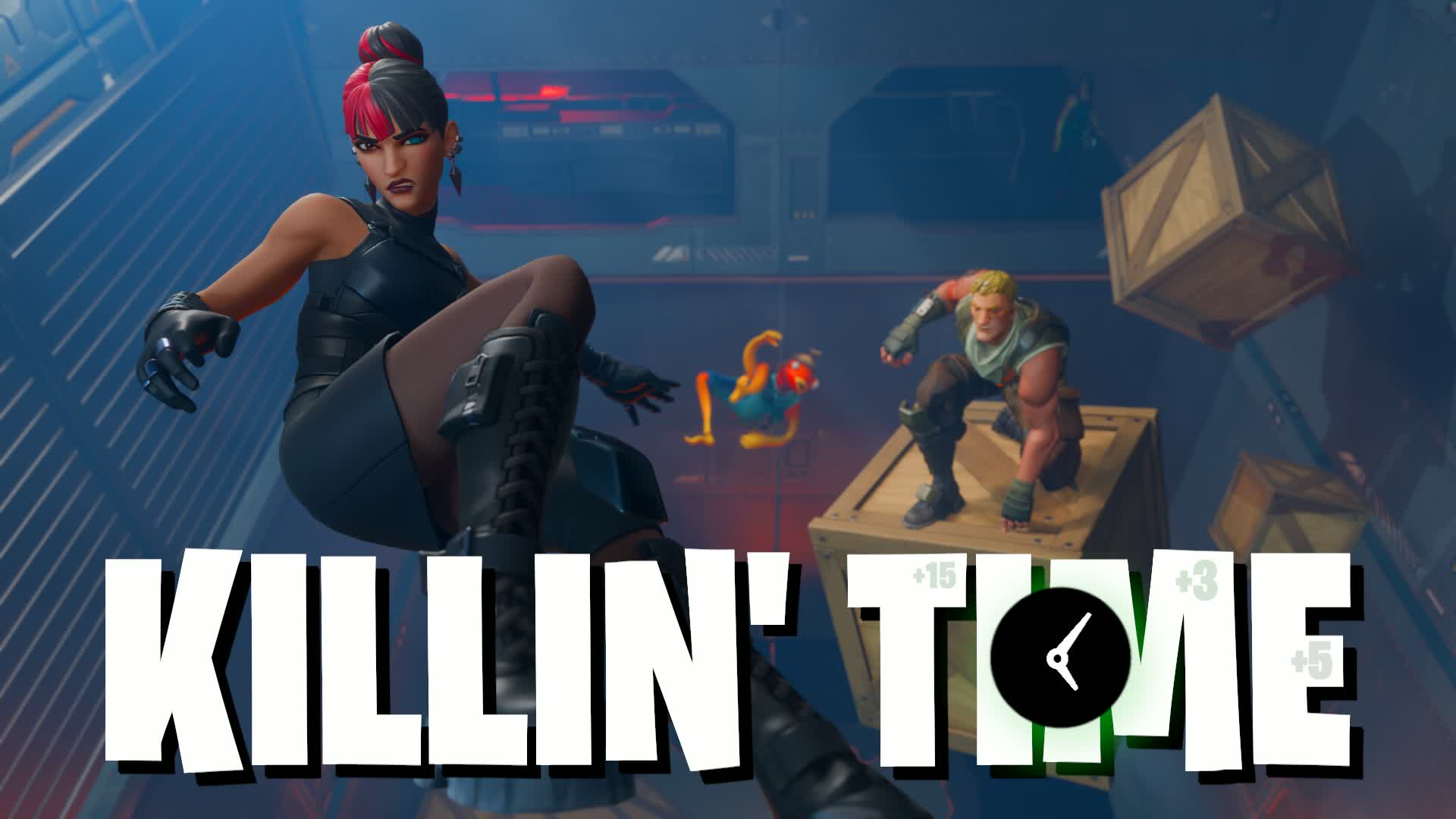
Our very first UEFN project, Killin’ Time, offered us a test bed for concepts and assets that form an integral part of Run, Gun, Repeat! It also taught our less experienced staff how to publish and handle post-production.
Killin’ Time is a Time-Based Roguelite game. The player must beat levels under a strict time constraint while killing enemies and collecting coins to extend the timer. Perks and powerful weapons unlock over time as the player gets stronger. We started out with ideation, writing all types of biomes and interesting locations for our levels. Four of the concepts we sketched out were chosen to be in the final game: Nightclub, Skyscraper, Space Station and Jungle. We then built the levels using Unreal Editor for Fortnite (UEFN) which features advanced tools and an extended asset library with over 15,000 assets to use.
Less is more.
Skyscraper was the first level that was made, a small vertical level that was non-linear. Here the player jumps from rooftop to rooftop fighting enemies that became more challenging as the level progressed. This focused our team on understanding the complexities of verticality and how it’s pacing can change depending on how high or low an objective is and the enemies surrounding it. One of the biggest lessons learned from this level was “Less is More”. Too many options results in overwhelm for players. Dialling the paths down made the level an instant favourite, with most players revisiting it.
Nightclub was made last, combining all of the lessons I learnt up until this point, navigation, enemy placement and encounter design. It was a non-linear spiral shaped club that involved the player breaching into a on-going rave overrun by enemies, there are over 5-10 different ways of reaching the end with scaling difficulty and challenging the player’s understanding of movement and time management.
Bigger on the inside.
Space Station was the most complex level to develop as it uses a low gravity mechanic, which changes the verticality drastically. The team learned valuable lessons about storage space and how to optimise it. They found creative ways to mask areas, and making the level seem bigger than it actually is. Through teleporters and sneaky wall placements, we were able to sell the illusion of a big space station on an asteroid. This is the most visually stunning level in the map, but there’s a little too much complexity to the player’s journey. This was a learning experience that stands us in good stead with our IP development.
Player journeys.
Jungle is the most difficult level to complete and was equally challenging to design. It took many days of planning in Krita with the whole team. The two lanes have to be interesting and reward the player for making any decision. Developing the journey for Jungle provided a real hands-on insight into the way that in-game decision making impacts and influences player behaviour.
Nightclub was the last level to be built, combining all of the lessons learned through the other three levels on navigation, enemy placement and encounter design. This is a non-linear spiral shaped club that involves the player breaching into a on-going rave overrun by enemies. There is a number of different ways to reach the end of the level, building on our understanding of decision making and player pathways. The level scales consistently over each possible pathway and challenges the player’s understanding of movement and time management.
Have you played Killin’ Time yet? Check it out on Fortnite – and remember to leave us a review!